Smart‑Home and Tech Abuse in California Family Law: Using SB 50 to Cut an Abuser’s Access to Devices
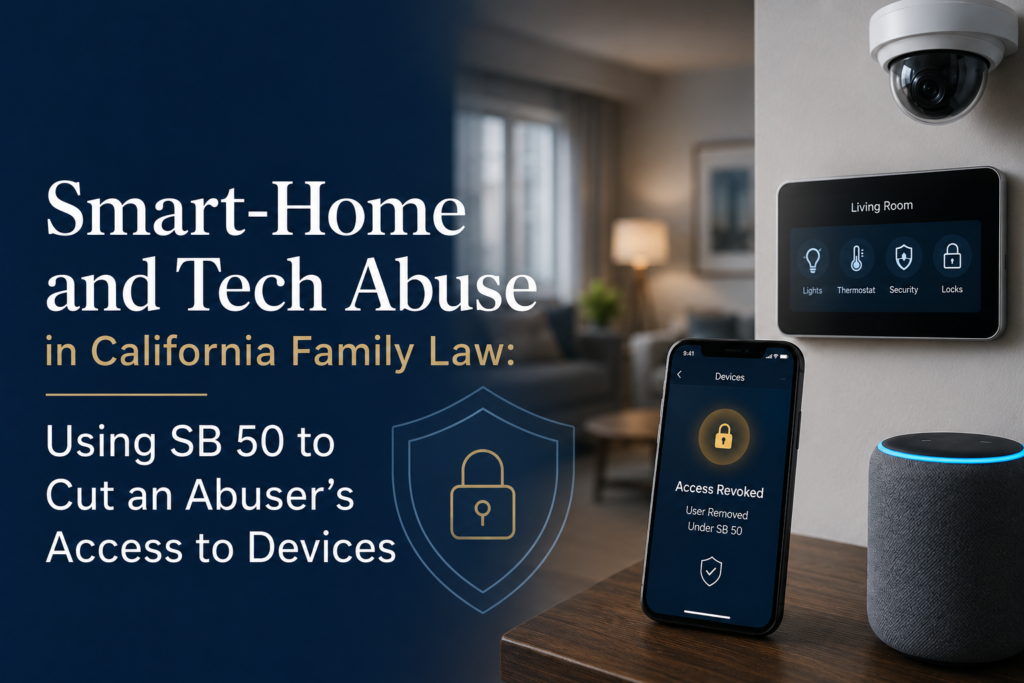
Aggressive Divorce Representation Available NowCall Us (805) 222-6766 Smart‑Home and Tech Abuse in California Family Law: Using SB 50 to Cut an Abuser’s Access to Devices New technology brings both convenience and new complications for families going through difficult legal matters. In California family law, smart-home devices can become instruments of abuse, making it crucial for courts to consider California device protection requests in family law when protecting victims. Recent legislative changes, including Senate Bill 50 (SB 50), give survivors of domestic violence new ways to protect themselves from tech-facilitated harm by partnering with a family law lawyer in California specializing in these evolving legal issues. When a divorce or separation occurs, the “smart” devices meant to enhance home life—like security cameras, remote locks, thermostats, or voice assistants—can be misused for stalking, intimidation, or harassment. Parents and children in Los Angeles, Ventura County, and throughout California increasingly ask family law lawyers how to remove an abuser’s digital and physical access to their homes. Being informed about options for smart home abuse in domestic violence California situations is now vital for anyone facing a high-conflict family law matter. A qualified family law attorney or certified family law specialist brings essential guidance to these serious family law matters, ensuring clients’ legal interests and the best interests of the children are always protected. This article explains how California family law, especially under SB 50 and relevant court procedures, can help protect individuals and their children from tech abuse. You will find guidance on how to use the legal process to cut off unwanted access, how courts evaluate California device protection request family law petitions, and what steps to take if you are worried about your children’s safety. The Law Offices of Seth C. Bowen, serving Southern California families with understanding and skill, can assist you with practical solutions tailored to your needs, including legal services such as child support, child custody, spousal support, property division, and business valuation for complex family law matters. How Family Law and Divorce Work in California California family law covers a wide range of legal issues, including divorce, child custody, child support, legal separation, spousal support, and the protection of victims of domestic violence. The state uses a no-fault divorce system, so couples can end their marriage based on irreconcilable differences without needing to prove wrongdoing by either spouse. This principle helps reduce conflict and keeps the focus on resolving marital issues fairly, particularly when there are children, complex assets, or retirement accounts involved. When dividing property, California follows a community property system. This means that, with limited exceptions, community estate assets and debts acquired during marriage are divided equally between spouses. Judges also consider claims like separate property tracing and business valuation, especially in high-asset divorces involving most assets or debts acquired during marriage. If an abuser has access to a smart home device registered during the marriage, the court can order changes to prevent misuse as part of community property division or through specific device protection requests. Child custody is always resolved by using the “best interest of the child” standard. Family law attorneys know that California courts look closely at factors such as abuse, parental involvement, types of legal custody, and each child’s unique needs. New laws, like those covering smart home abuse and domestic violence in California, allow judges to restrict an abusive parent’s access to children or residences—including technology that could enable harassment. The Law Offices of Seth C. Bowen regularly helps clients across Los Angeles County, San Francisco, San Jose, San Diego, Orange County, and Ventura County navigate these complex custody and technology-related concerns, forming the foundation for favorable outcomes in both family law litigation and collaborative law proceedings. Step-by-Step Legal Process for Device Protection in California Family Law Document all incidents and gather evidence. Victims should record instances of harassment, unauthorized access, or threats involving smart home devices. Photos, emails, text messages, and screenshots help build a strong case and may ultimately protect the best interests of your family. Consult a family law lawyer in California with experience handling domestic violence, domestic violence restraining orders, and device protection matters. An experienced family law attorney can assess whether your facts justify a California device protection request or a family law petition under current statutes and SB 50. File a request for a domestic violence restraining order (DVRO). Include specific information about how smart devices were used to commit abuse or harassment and request that the court order the abuser’s access removed, considering issues of legal custody and safety for the children. Serve the restraining order and accompanying documents on the other party. The proof of service must be filed with the court, verifying that all papers have been properly delivered as part of the legal process in California family law litigation. Prepare for the hearing. Collect additional information, consult your family law attorney, possibly a certified family law specialist, and be ready to testify or present evidence about technology misuse and its effect on you and your children. Attend the court hearing. Present your evidence and explain how restricting device access will protect your safety and the interests of your children, ensuring family law litigation results in the most effective legal protections. If granted, follow the court’s instructions to change passwords, remove registrations, or reprogram devices. Work with your attorney and, if needed, law enforcement to enforce the court’s orders quickly and completely. Filing for protection under California family law starts with documenting every relevant detail. Timelines, messages, or even a security log from a device can demonstrate the seriousness of the situation to the court. A certified family law specialist will help you decide the best course of action and make sure your request includes all necessary legal elements under both state law and the new requirements of SB 50, and can assist with related collateral legal matters. The court considers whether technology has been used to stalk, monitor, or
When Your Ex Ignores Family Court Orders in California: Enforcement, Contempt, and Next Steps
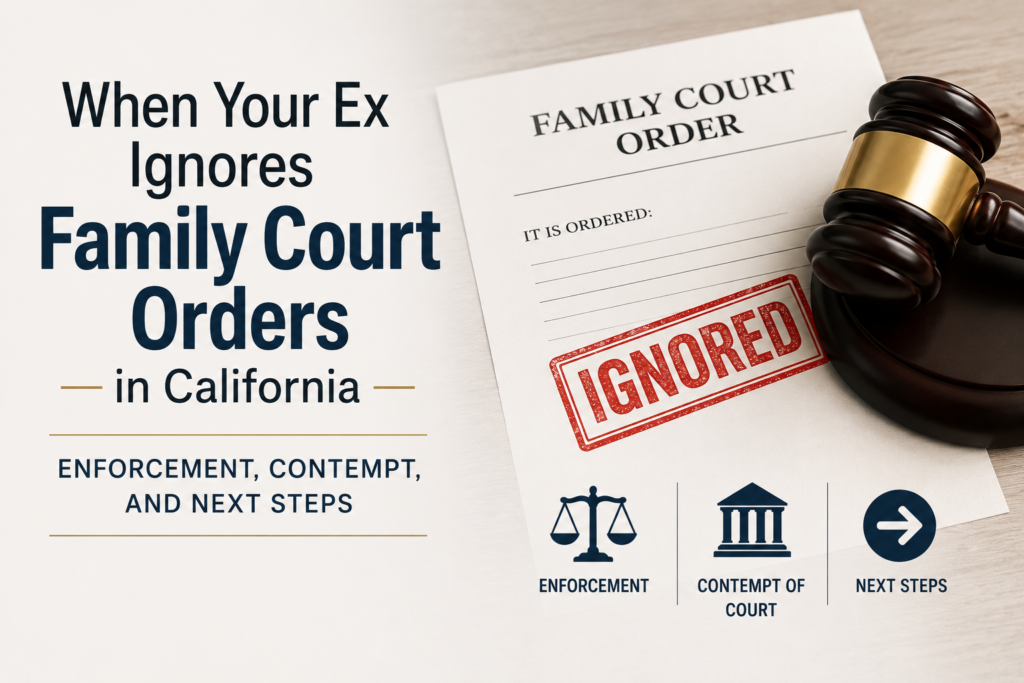
Aggressive Divorce Representation Available NowCall Us (805) 222-6766 When Your Ex Ignores Family Court Orders in California: Enforcement, Contempt, and Next Steps Understanding California’s Approach to Family Law and Divorce Family law in California can be a complex area due to its specific state principles that prioritize fairness and the best interests of children. The state operates under a “no-fault” divorce model, allowing couples to dissolve their marriage without assigning blame. This is particularly relevant in Los Angeles County and Ventura County, where local courts manage a diverse array of family law matters from child support to property division. In community property matters, California means business. Assets and debts accumulated during a marriage are typically split equally, unless a prenuptial agreement says otherwise. This is a key consideration for anyone facing a divorce in Tarzana or the surrounding areas. What to Do When Your Ex Ignores a California Custody Order Ignoring a custody order can create significant disruptions. The best approach to such situations is practical legal intervention aimed at enforcement. California treats family court orders seriously, ensuring that children’s welfare comes first. Whether you’re dealing with custody orders or spousal support mandates, there are steps you can take to ensure compliance. Enforcing Family Court Orders in California Enforcement is a key area of family law in California, especially when dealing with non-compliance. Whether in Tarzana, Oxnard, or other cities in Southern California, the process remains consistent: File a motion for contempt. This serves as a formal way to bring the issue before a court. Show evidence of non-compliance, establishing that your ex is ignoring court orders. Seek remedies such as wage garnishment or seizure of assets to cover unpaid child or spousal support. Enlist the help of family law professionals like those at the Law Offices of Seth C. Bowen for guidance. Key Steps in the Family Law and Divorce Process in California The divorce process in California is methodical and can be outlined as follows: Filing the Petition: The divorce process begins with filing a divorce petition with the local family court. Service of Papers: Serve the divorce papers to your spouse, ensuring proof of service is filed with the court. Waiting Period: Observe the state-mandated six-month waiting period. Preliminary Declaration of Disclosure: Both parties must complete and exchange preliminary financial disclosures. Mediation: Encouraged but not required for contested child custody or visitation issues before court hearings. Property Division: Split community property and debts, following the 50/50 division rule or as negotiated in agreements. Finalizing the Divorce: After resolving all issues and drafting a marital settlement agreement, submit it for court approval. Specialized Family Law Services in Tarzana, California The Law Offices of Seth C. Bowen provides comprehensive legal services, addressing all facets of family law: Child Custody Children’s Rights and Welfare Child Support Divorce Domestic Violence Fathers’ Rights Grandparents’ Rights Modifying Court Orders Paternity Postnuptial Agreements Their commitment to client-centered service is supported by the team’s deep roots and active engagement in the legal communities of Los Angeles and Ventura Counties. Establishing the Firm’s Experience and Local Presence The Law Offices of Seth C. Bowen have been a stronghold for families navigating legal issues in Tarzana and beyond. Seth C. Bowen’s educational journey began at Loyola Marymount University, culminating at Chapman University School of Law. His involvement with the San Fernando Valley Bar Association and Los Angeles County Bar Association underscores his dedication to excellence. Notably, in 2022, Expertise.com listed the firm among the Best Divorce Lawyers in Ventura, recognizing their commitment to quality legal support. FAQs About Family Law and Divorce in California What can I do if my ex ignores a California custody order? You can file a motion for contempt in family court, providing evidence of the non-compliance to seek enforcement of the order. How are child support amounts determined in California? Child support is calculated using a statewide guideline formula, which considers both parents’ incomes and other relevant factors. What does ‘no-fault’ divorce mean in California? It means you can file for a divorce based on irreconcilable differences without proving fault or wrongdoing by either spouse. How does mediation work in California child custody cases? Mediation is encouraged for contested custody or visitation issues, providing a space for parents to negotiate with the help of a neutral third party. Under what conditions can spousal support be modified? Modifications are based on significant changes in circumstances, such as shifts in income or employment status, and require court approval. Taking the Next Step Toward Resolution Navigating the complexities of family law can feel overwhelming, but you don’t have to do it alone. At the Law Offices of Seth C. Bowen, we’re here to help you find practical, personalized solutions. Contact us today for a free initial consultation and let our experienced team guide you through this process. Visit our website at https://sethbowenlaw.com/ to learn more. Law Offices of Seth C. Bowen 19318 Ventura Boulevard, Suite 102, Tarzana, CA 91356 📞 (805) 222-6766 This article is for informational purposes only and does not constitute legal advice. Every case is unique. Consult a licensed California family law attorney for guidance specific to your situation.
Stepparent Adoption in California: Step-by-Step Guide for Blended Families
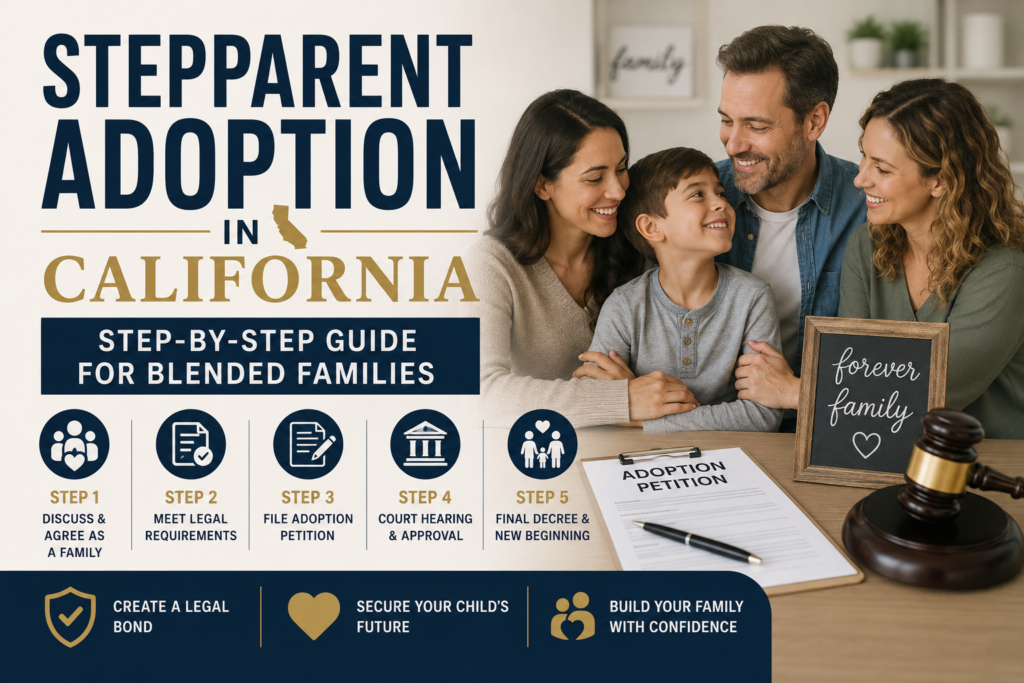
Aggressive Divorce Representation Available NowCall Us (805) 222-6766 Stepparent Adoption in California: Step-by-Step Guide for Blended Families Understanding Stepparent Adoption in Tarzana, California Blended families in Tarzana and across Los Angeles County often seek to formalize their familial bonds through stepparent adoption. Whether you’re enjoying a day at Tarzana Park or navigating the local community’s bustling streets, having your stepparent legally recognized as a parent provides security and stability for your family. The emotional and legal benefits of formal adoption can strengthen the family unit, ensuring that your child enjoys the same rights and privileges as a biological child, including inheritance benefits and the assurance of care should anything happen to the biological parent. Key Aspects of Stepparent Adoption Under California Family Law California law allows for a straightforward stepparent adoption process, which simplifies the usual adoption procedures once certain conditions are met. This often includes obtaining consent from the noncustodial biological parent or demonstrating their lack of involvement or abandonment, which is legally considered when they have not communicated or supported the child for a year. Tarzana families contemplating this legal route should understand that California law emphasizes the child’s best interests, similar to standards applied in child custody and support matters. Steps in the Stepparent Adoption Process in California Understanding the procedural steps can make navigating a stepparent adoption more manageable. Here’s what families can typically expect: Initial Consultation: Begin with a conversation with a family law attorney to understand your situation. Filing the Adoption Request: Submit a formal request to the court, which includes comprehensive documentation detailing the child’s situation and the adoption’s purpose. Consent from Other Parent: Secure the noncustodial parent’s consent or, alternatively, pursue termination of their parental rights if they’ve abandoned the child or are unresponsive. Investigation: Undergo a home investigation conducted by a social worker or family court mediator to assess the child’s environment. Court Hearing: Attend a court hearing where a judge reviews the case details and potentially finalizes the adoption. Family Law Services Offered by the Law Offices of Seth C. Bowen The Law Offices of Seth C. Bowen in Tarzana offers a range of services to support families through various legal challenges: Child Custody Children’s Rights and Welfare Child Support Divorce Domestic Violence Fathers’ Rights Grandparents’ Rights Modifying Court Orders Paternity Postnuptial Agreements Why Choose the Law Offices of Seth C. Bowen? Serving Los Angeles County and Ventura County, the Law Offices of Seth C. Bowen provides not only a deep understanding of the local courts but also a genuinely personal approach to legal assistance. Seth C. Bowen’s education from Loyola Marymount University and Chapman University School of Law underpins his commitment to accessible legal solutions. A member of both the San Fernando Valley Bar Association and the Los Angeles County Bar Association, Seth ensures his practice remains at the forefront of legal excellence. Recognized in 2022 by Expertise.com as one of the Best Divorce Lawyers in Ventura, the firm’s dedication to client-centered solutions stands out in every case handled. FAQs About Stepparent Adoption in California Does the other biological parent need to consent to a stepparent adoption? Yes, typically, the noncustodial biological parent must consent unless their rights have been terminated due to abandonment or other legal grounds. Can an adopted stepchild inherit from their stepparent? Yes, once adopted, the stepchild has the same rights of inheritance from the stepparent as a biological child. How long does the stepparent adoption process usually take? The process can vary but typically ranges from several months to over a year, depending on the complexity of securing consent and court schedules. What happens if the other biological parent opposes the adoption? If the other parent opposes the adoption, the court may need to assess the situation more thoroughly, potentially leading to a contested adoption proceeding. Are there age restrictions for a stepparent wishing to adopt? Generally, the adopting stepparent must be at least 18 years old and significantly older than the child. Contact Us for a Free Consultation Stepparent adoption is a meaningful step towards solidifying family bonds legally and emotionally. To discuss your specific situation and learn more about how the Law Offices of Seth C. Bowen can assist, we invite you to reach out for a free initial consultation. Visit [our website](https://sethbowenlaw.com/) or call us directly to take the next step forward. Law Offices of Seth C. Bowen 19318 Ventura Boulevard, Suite 102, Tarzana, CA 91356 📞 (805) 222-6766 This article is for informational purposes only and does not constitute legal advice. Every case is unique. Consult a licensed California family law attorney for guidance specific to your situation.
Post‑Judgment Modification in California: Changing Support and Custody When Life Changes
Aggressive Divorce Representation Available NowCall Us (805) 222-6766 Post‑Judgment Modification in California: Changing Support and Custody When Life Changes Understanding Post-Judgment Modifications in California Life evolves, and situations that once seemed stable can change rapidly. In California, especially in places like Tarzana nestled in the heart of Los Angeles County, families often find themselves needing to revisit court orders related to child support or custody. The legal system here recognizes that changes, such as job loss or relocation, can impact ability to adhere to previous agreements. The Legal Framework for Modifying Support and Custody California law allows for the modification of child support and custody orders if circumstances significantly change. The law’s focus remains on the best interests of the child, emphasizing their health, safety, and welfare in every decision. For any modification to be approved, the change in circumstances must be demonstrable and significant. Establishing a Significant Change To begin modifying a court order, it must be shown that a significant change in circumstances has occurred. This could include: Income changes due to job loss or promotion Changes in living arrangements Significant changes in the child’s needs Health conditions affecting either parent or child Step-by-Step Process for Modifying Court Orders Navigating the post-judgment modification process in California involves several steps: Consultation with Legal Counsel: Work with an experienced family law attorney to assess the changes and grounds for modification. Filing a Motion: You must file a motion with the court to request a modification of existing orders. Serve Notification: Proper legal procedures must be followed, including notifying the other party. Court Mediation: If involving children, attend mediation to resolve issues collaboratively. Court Hearing: Present your case in court if mediation doesn’t resolve the issue. Judge’s Decision: A judge will decide based on evidence of changed circumstances and the child’s best interests. Avoiding Common Pitfalls Skipping mediation, which is often encouraged in cases involving children Failing to provide substantial evidence of changed circumstances Ignoring the requirement to file appropriate documents in modification-related processes Legal Services Offered by Our Firm At the Law Offices of Seth C. Bowen, we provide a diverse range of family law services, including: Child Custody Children’s Rights and Welfare Child Support Divorce Domestic Violence Fathers’ Rights Grandparents’ Rights Modifying Court Orders Paternity Postnuptial Agreements Local Expertise and Professional Recognition The Law Offices of Seth C. Bowen serves families across Los Angeles County and Ventura County. Our founding attorney, Seth C. Bowen, completed his legal education at prestigious Southern California institutions, including Loyola Marymount University and Chapman University School of Law. He is an active member of both the San Fernando Valley Bar Association and the Los Angeles County Bar Association, reflecting our firm’s commitment to excellence. Recognized by Expertise.com as among the Best Divorce Lawyers in Ventura in 2022, we pride ourselves on providing personalized legal solutions. FAQs on Post-Judgment Modification When can I modify child support or custody orders in California? Modifications are possible when there’s a significant change in circumstances affecting the current order. This could include changes in income, living arrangements, or the health conditions of parties involved. Do I need a lawyer to modify a court order in California? While not legally required, having a knowledgeable family law attorney can help navigate the process effectively, ensuring all legal requirements are met. What qualifies as a significant change in California family law? Significant changes might include a substantial increase or decrease in income, a move to a different city, or changes in the child’s health needs. Is mediation necessary for modifying custody orders? Mediation is often encouraged in California before a judge will hear contested custody matters, focusing on settling issues in the child’s best interests. How long does it take to modify a custody or support order? The timeline depends on specific case details but can vary from a few months to longer, depending on court schedules and the complexity of the changes. Contact Us for More Information If you’re facing changes in your life that affect your family court orders, the Law Offices of Seth C. Bowen is here to help. With our commitment to providing accessible and personal legal representation, we invite you to explore how we can assist you. Contact us today for a free initial consultation by visiting https://sethbowenlaw.com/. Law Offices of Seth C. Bowen 19318 Ventura Boulevard, Suite 102, Tarzana, CA 91356 📞 (805) 222-6766 This article is for informational purposes only and does not constitute legal advice. Every case is unique. Consult a licensed California family law attorney for guidance specific to your situation.
New 2026 California Child Support Laws: What Parents Need to Know Before Going Back to Court
Aggressive Divorce Representation Available NowCall Us (805) 222-6766 New 2026 California Child Support Laws: What Parents Need to Know Before Going Back to Court Navigating Family Law in Tarzana, California Imagine living in Tarzana, a family-friendly neighborhood in the heart of the San Fernando Valley, filled with community parks and top-rated schools. It’s a place many families call home, nestled conveniently between the vibrant streets of Los Angeles and the beautiful coastal landscapes of Ventura County. Yet, when legal issues arise, such as changes in child support or divorce proceedings, the need for effective legal guidance becomes apparent. Understanding California’s Family Law and Divorce Framework California governs family law and divorce under several key principles aimed at fair and equitable outcomes. As a no-fault divorce state, California allows spouses to file for divorce without proving wrongdoing; irreconcilable differences suffice. For property division, California’s community property laws generally require an equal split of all properties acquired during marriage. Child custody decisions focus on the best interests of the child, applying state guidelines to determine child support based on income and time spent with the child. Detailed Steps in Divorce and Family Law Cases Understanding the step-by-step process can demystify the journey you are about to embark on in family law cases. Initiation: Begin by filing a petition for dissolution of marriage with the court. Serving Papers: Serve the divorce papers to your spouse and ensure proof of service is filed with the court. Initial Orders: Request temporary orders if necessary, dealing with spousal support or child custody during the process. Mandatory Disclosures: Both parties must exchange a Preliminary Declaration of Disclosure, revealing financial information. Mediation: Engage in mediation for contested child custody or visitation matters, as encouraged by California law. Drafting Agreements: Attempt to reach a settlement through negotiation or mediation. Trial: If no agreement is reached, the matter proceeds to trial where a judge will make determinations. Final Judgment: Finalize and sign the judgment of dissolution, completing the process unless modifications are sought later on. The New Landscape in California Child Support Law With Senate Bill 343 coming into effect on September 1, 2024, updated child support laws continue to reflect California’s economic landscape and cost of living. These new statutes directly impact how child support is calculated, requiring adaptation from those currently navigating or revisiting child support agreements. Comprehensive Family Law Services in Tarzana The Law Offices of Seth C. Bowen offers a wide range of family law services to help clients facing these challenges head-on: Divorce Child Custody Children’s Rights and Welfare Child Support Domestic Violence Fathers’ Rights Grandparents’ Rights Modifying Court Orders Paternity Postnuptial Agreements Our team provides personal guidance for each service to ensure clients’ needs are addressed diligently. Firm Experience in Tarzana and Surrounding Areas Serving families across Los Angeles and Ventura Counties, the Law Offices of Seth C. Bowen draws from years of experience grounded in local communities. From his education at Chapman University School of Law to his active involvement in the San Fernando Valley and Los Angeles County Bar Associations, Seth C. Bowen’s focus is on accessible and personalized family law solutions. The firm’s recognition as one of Expertise.com’s Best Divorce Lawyers in Ventura in 2022 highlights its dedication to quality representation. Frequently Asked Questions How do the 2026 California child support changes affect my case? The changes align with the state’s cost of living adjustments. You may need to revisit existing child support orders to ensure compliance with new guidelines. Can we file for divorce without a separation period in California? Yes, California does not require a separation period before filing for divorce. What happens if my spouse does not respond to divorce papers in California? If your spouse fails to respond within 30 days, you may request a default judgment from the court. How does domestic violence affect child custody decisions in California? Domestic violence findings create a presumption against awarding custody to the abusive parent, making it unlikely for them to get joint or sole custody. What if we agree on everything in our divorce? You can file a joint petition for an uncontested divorce, which may expedite the process as long as all agreements are documented and compliant with legal standards. Ready to Navigate Your Family Law Matters? If you are facing changes in child support or any other family law issues in Tarzana or the surrounding areas, we invite you to reach out for a personalized consultation. The Law Offices of Seth C. Bowen offer a free initial consultation, allowing us to provide legal guidance tailored to your unique situation. Visit us online at https://sethbowenlaw.com/ or call us today to explore how we can assist you with your family law needs. Law Offices of Seth C. Bowen 19318 Ventura Boulevard, Suite 102, Tarzana, CA 91356 📞 (805) 222-6766 This article is for informational purposes only and does not constitute legal advice. Every case is unique. Consult a licensed California family law attorney for guidance specific to your situation.
How Social Media and Text Messages Can Hurt Your California Divorce Case
Aggressive Divorce Representation Available NowCall Us (805) 222-6766 How Social Media and Text Messages Can Hurt Your California Divorce Case Can Social Media Posts Be Used as Evidence in a California Divorce? In our hyper-connected world, social media and text messages have become integral to daily communication. However, their impact extends beyond mere exchanges, particularly when entangled in legal battles like divorce. In California, digital evidence from social media platforms can indeed play a significant role in divorce proceedings. Posts and messages can reflect financial status, lifestyle, and even character, which may influence outcomes in spousal support and custody arrangements. Understanding how digital communication can be used in court is crucial for families undergoing divorce in Tarzana, California. The Legal Standards for Digital Evidence in Divorce The California Family Code governs family law, including the incorporation of digital evidence. Unlike speculative predictions, social media posts and text messages are admissible in California courts if they fulfill certain criteria. For evidence to be considered, it must be relevant, authentic, and not infringe on privacy rights. Importantly, anything shared publicly online might be scrutinized and used as evidence. This underlines the importance of maintaining careful communication practices during divorce proceedings. How Family Law and Divorce Cases Work in California Divorce in California is guided by the principle of “no-fault.” This means divorce can be pursued based on irreconcilable differences, without needing to demonstrate wrongdoing. The state adopts a community property rule, mandating equal division of assets and debts accrued during the marriage unless exceptions apply. The courts prioritize the best interests of children in custody cases, often considering joint custody as a desirable arrangement. Aspects like spousal and child support are determined following set guidelines and considering factors such as income, marriage duration, and financial needs. Step-by-Step Process for Family Law and Divorce in California Navigating a divorce requires understanding a series of procedural steps. Here’s what residents of Tarzana and Ventura County can expect: Filing a Petition: The divorce process begins by filing a petition for dissolution of marriage with the court. Serving the Other Party: The filed petition must be served to the other party, and proof of service should be recorded with the court. Response from the Respondent: The spouse being served must respond within 30 days. Preliminary Declaration of Disclosure: Both parties are required to exchange complete financial information early in the process. Negotiating Settlements: Efforts to reach agreement on property division, custody, and support occur at this stage. Temporary Orders: Courts may issue temporary orders for custody, support, or property use through the divorce proceedings. Mediation: Especially in contested custody cases, mediation is often required before proceeding to trial. Trial or Agreement: If agreements are reached, the divorce can proceed without trial; otherwise, contested issues will be decided by a judge. Finalizing the Divorce: The divorce is finalized when the court issues a judgment of dissolution. Family Law Services Offered by Our Firm The Law Offices of Seth C. Bowen offer comprehensive family law services tailored to meet the unique needs of families in Los Angeles County and Ventura County: Divorce Child Custody Children’s Rights and Welfare Child Support Domestic Violence Fathers’ Rights Grandparents’ Rights Modifying Court Orders Paternity Postnuptial Agreements With a commitment to personalized legal support, this range ensures representation that understands the intricacies of each situation. The Firm’s Experience and Local Presence Rooted in Southern California, Seth C. Bowen earned his law degree from Chapman University School of Law after completing studies at Loyola Marymount University. His familiarity with Los Angeles County’s communities and courts is indispensable. At the Law Offices of Seth C. Bowen, a client-centered approach ensures personalized service. The firm is recognized by Expertise.com as one of the Best Divorce Lawyers in Ventura 2022. Serving families across Los Angeles and Ventura Counties, membership in the San Fernando Valley Bar Association and the Los Angeles County Bar Association underscores Seth’s commitment to excellence in local legal practice. FAQs Can my spouse legally use my social media posts against me in a divorce? Yes, any public posts or messages deemed relevant and authentic can be used as evidence in California divorce proceedings. How is child support determined in a California divorce? Child support is calculated using California’s statewide guideline formula, which considers parents’ incomes, time spent with children, and specific financial needs. What is the significance of a 10-year marriage in California divorce law? A marriage lasting 10 years or more is considered a long-term marriage, which may impact the duration of spousal support unless otherwise ordered by the court. Are mediation sessions mandatory in California child custody disputes? Yes, California requires mediation in contested child custody cases before a judge will hear the matter. How does California treat property division in a divorce? California follows the community property rule, generally dividing all assets and debts acquired during the marriage equally between the spouses unless exceptions apply. Taking the Next Steps Divorce can be an emotionally taxing and legally complex process. At the Law Offices of Seth C. Bowen, we strive to provide guidance and advocacy that prioritizes your family’s best interests. Contact us today for a free initial consultation at (805) 222-6766 or visit https://sethbowenlaw.com/ to learn how we can assist you with your family law needs in Tarzana and beyond. Law Offices of Seth C. Bowen 19318 Ventura Boulevard, Suite 102, Tarzana, CA 91356 📞 (805) 222-6766 This article is for informational purposes only and does not constitute legal advice. Every case is unique. Consult a licensed California family law attorney for guidance specific to your situation.
Five Costly Parenting Plan Mistakes California Parents Make in Joint Custody Cases
Aggressive Divorce Representation Available NowCall Us (805) 222-6766 Five Costly Parenting Plan Mistakes California Parents Make in Joint Custody Cases Navigating Parenting Plans in California Creating a parenting plan is a crucial component of joint custody arrangements in California. Parents residing in areas like Tarzana, located in the vibrant Los Angeles County, often wonder about errors they might unknowingly commit when setting up these plans. Understanding the legal landscape and preparing adequately can prevent future conflicts for families in Ventura County and beyond. Common Mistakes to Avoid in Joint Custody Cases Failing to Focus on the Best Interests of the Child In California, custody decisions are hinged on what serves the best interests of the child. Failing to prioritize a child’s health, safety, and welfare can result in court disputes. Parents should avoid decisions that appear self-serving, as courts consider the child’s needs paramount. Overlooking Detailed Scheduling Parents often make the mistake of inadequate scheduling. Joint custody requires clear terms regarding drop-offs, pick-ups, holidays, and vacations. Without specific details, misunderstandings can easily occur. Precise scheduling within the context of California’s rules can mitigate this risk. Neglecting Communication Provisions Effective communication between co-parents is essential. Common parenting mistakes include ignoring how communications about the child’s activities and needs will be handled. Including guidelines for regular updates in the parenting plan is recommended. Forgetting to Account for Future Changes Life in bustling Southern California means plans may change. Parents often overlook the need for flexibility and future modifications. Including provisions for possible changes in circumstances ensures adaptability without significant disruptions. Skipping Mediation In California, mediation is encouraged before custody disputes are heard in court. Skipping this step or entering unprepared can hinder resolution. Taking mediation seriously can smoothen the process significantly. Understanding Family Law and Divorce in Tarzana, California Residents of Tarzana and surrounding areas like Ventura County are served by family law specialists who deeply understand local legal procedures. California is a no-fault divorce state, which simplifies the process as proving wrongdoing is unnecessary. Additionally, the state’s community property principles guide the equal division of assets acquired during the marriage. Step-by-Step Legal Process for Divorce and Custody Cases When pursuing Family Law and Divorce cases in California, understanding the process can help ease anxiety and increase preparedness. The steps generally include: Meeting the six-month residency requirement for one party. Filing the initial petition for divorce or custody modification. Serving the other party and filing a proof of service with the court. Exchanging a Preliminary Declaration of Disclosure of assets and debts. Entering negotiations or mediation, particularly for custody matters. If agreements are reached, filing a joint petition for uncontested divorces. Attending court hearings if disputes remain unresolved. Finalizing the divorce after a mandatory six-month waiting period post-service. Comprehensive Family Law Services Offered The Law Offices of Seth C. Bowen in Tarzana provide extensive family law services to ensure comprehensive support for every client: Child Custody Children’s Rights and Welfare Child Support Divorce Domestic Violence Fathers’ Rights Grandparents’ Rights Modifying Court Orders Paternity Postnuptial Agreements Why Choose the Law Offices of Seth C. Bowen The Law Offices of Seth C. Bowen boasts a strong connection with local communities in Los Angeles County and Ventura County. Seth C. Bowen is highly educated with degrees from Loyola Marymount University and Chapman University School of Law, giving him an in-depth understanding of Southern California’s legal scene. His active membership in prestigious institutions like the San Fernando Valley Bar Association and the Los Angeles County Bar Association further reflects his commitment to professional excellence. Recognized by Expertise.com as one of Ventura’s Best Divorce Lawyers, the firm’s reputation ensures reliable support for families. Frequently Asked Questions What is the “best interest of the child” standard? In California, decisions regarding child custody are based on this standard, emphasizing factors like the child’s health, safety, welfare, and overall well-being. How are child support payments determined? California uses a statewide guideline that takes into account parents’ incomes and the child’s time with each parent. What does community property mean in a divorce? It means all assets and debts acquired during the marriage are typically divided equally unless specific exceptions apply. How long do I have to wait to finalize a divorce in California? There is a mandatory six-month waiting period after the service of divorce papers before a divorce can be finalized. Can parenting plans be modified easily in California? Modifying court orders requires demonstrating a significant change in circumstances, and it’s best to consult with a legal expert for guidance. Taking the Next Steps For personalized assistance and guidance through your family law matters, the Law Offices of Seth C. Bowen offers a free initial consultation to help you make informed decisions. Reach out today by visiting https://sethbowenlaw.com/ and learn how our experienced legal team can support you and your family. Law Offices of Seth C. Bowen 19318 Ventura Boulevard, Suite 102, Tarzana, CA 91356 📞 (805) 222-6766 This article is for informational purposes only and does not constitute legal advice. Every case is unique. Consult a licensed California family law attorney for guidance specific to your situation.
Financial Disclosure and Hidden Assets in California Divorce: What You Must Reveal by Law

Aggressive Divorce Representation Available NowCall Us (805) 222-6766 Financial Disclosure and Hidden Assets in California Divorce: What You Must Reveal by Law Understanding Financial Disclosure in Tarzana, California Nestled in the San Fernando Valley, Tarzana is a vibrant community with proximity to the bustling Los Angeles metropolitan area. Residents here enjoy the mix of urban convenience and suburban tranquility, making it a unique place for families. If you’re navigating a divorce in Tarzana or the surrounding areas of Los Angeles and Ventura County, understanding the intricacies of California’s financial disclosure requirements is imperative. The Law Offices of Seth C. Bowen, located right on Ventura Boulevard, is well-situated to guide you through the divorce process, ensuring you comply with state laws while protecting your interests. The Legal Framework of Financial Disclosure in California Divorce California is a “no-fault” divorce state, which simplifies the divorce initial process since neither spouse needs to prove wrongdoing. However, a crucial part of any divorce proceeding is the mandatory financial disclosure, where both spouses must openly share comprehensive details of their financial situations. This includes all community property, separate assets, and debts. The Preliminary Declaration of Disclosure is a legally binding part of the divorce process, requiring transparent and accurate revelation of all financial holdings. This allows for an equal division of assets and debts, adhering to California’s community property laws. Common Challenges: Hidden Assets and Family Law in California While California law mandates transparent financial disclosure, some divorcing spouses may attempt to hide assets to gain unfair advantages. Spouses might conceal funds or underreport income, creating significant challenges. It’s crucial to work with an experienced family law attorney who can identify potential red flags and ensure that all financial information is appropriately disclosed. Knowing about “hidden assets California family law” and understanding the serious implications of attempting to conceal assets can protect you from future legal repercussions. Step-by-Step Guide to the California Divorce Process Navigating the divorce process can be daunting, but knowing the step-by-step procedures can make it less overwhelming. Here’s what you can generally expect: File for Divorce: Initiate the process by filing a Petition for Dissolution of Marriage with the Superior Court in the appropriate county. Serve Papers: After filing, legally serve the divorce petition and summons on your spouse, and file proof of service with the court. Response: The served spouse responds within 30 days, potentially highlighting any disagreements. Preliminary Declaration of Disclosure: Both parties exchange financial information to ensure transparent asset division. Custody and Support Mediation: If children are involved, mediation is encouraged to address custody and support issues but is not mandatory. Negotiation or Trial: If disputes remain, the parties enter negotiations, or the case proceeds to trial for judicial resolution. Final Judgment: Once an agreement is reached or a court decision is made, the divorce is finalized with a signed judgment. The Role of the Law Offices of Seth C. Bowen With a strong focus on practical and personalized legal solutions, the Law Offices of Seth C. Bowen serves families across Los Angeles County and Ventura County. Seth Bowen’s academic roots in Loyola Marymount University and Chapman University School of Law underscore his legal expertise. As a recognized member of the San Fernando Valley Bar Association and Los Angeles County Bar Association, Seth ensures that clients receive the highest caliber of representation. The firm’s recognition by Expertise.com as one of the Best Divorce Lawyers in Ventura further exemplifies its commitment to exceptional service. Comprehensive Family Law Services At the Law Offices of Seth C. Bowen, a variety of family law and divorce services are offered to meet the diverse needs of clients. Here is a list of some of these services: Child Custody Children’s Rights and Welfare Child Support Divorce Domestic Violence Fathers’ Rights Grandparents’ Rights Modifying Court Orders Paternity Postnuptial Agreements Whether you’re concerned about property division or navigating child custody issues, our team is dedicated to providing client-centered support throughout your legal journey. FAQ Section What happens if my spouse hides assets in a California divorce? Hiding assets during a divorce in California is illegal and can lead to serious legal consequences, including fines and a potential allocation of the hidden asset to the other spouse. Consult with a family law lawyer to address this issue promptly. How does community property affect asset division in a California divorce? In California, most assets and debts acquired during the marriage are considered community property and are divided equally between spouses unless a prenuptial agreement specifies otherwise. Do I need a lawyer to handle financial disclosure in a divorce? While not required, having an experienced family law attorney can help ensure complete and accurate financial disclosure, protecting your rights and interests throughout the divorce process. What if we agree on asset division, do we still need a Preliminary Declaration of Disclosure? Yes, even if there is mutual agreement, both parties must complete the Preliminary Declaration of Disclosure to comply with California’s legal requirements. How are child custody decisions made in California? Child custody decisions are based on the best interest of the child standard, with courts often encouraging joint custody arrangements to benefit the child’s welfare. Take the Next Step with Confidence Are you ready to discuss your family law needs? The Law Offices of Seth C. Bowen offers a free initial consultation to help you understand your options and decide the best course of action. Visit us online at https://sethbowenlaw.com/ for more information or to schedule your consultation. Our firm is dedicated to guiding you through every step with clarity, compassion, and expert legal guidance. Law Offices of Seth C. Bowen 19318 Ventura Boulevard, Suite 102, Tarzana, CA 91356 📞 (805) 222-6766 This article is for informational purposes only and does not constitute legal advice. Every case is unique. Consult a licensed California family law attorney for guidance specific to your situation.
Gray Divorce in California: Protecting Retirement, Home Equity, and Support After 50

Aggressive Divorce Representation Available NowCall Us (805) 222-6766 Gray Divorce in California: Protecting Retirement, Home Equity, and Support After 50 Understanding Gray Divorce in Tarzana, California Divorce after 50, often referred to as “gray divorce,” brings unique challenges, particularly in areas like Tarzana, California. With its close-knit communities in Los Angeles County, including the vibrant Ventura County, couples face decisions about dividing retirement accounts, home equity, and spousal support—a focus for many in this life stage. Local residents navigating gray divorce must consider California’s specific legal processes and community dynamics. Family Law and Divorce Procedures in California In California, family law cases including divorce are guided by principles such as community property and no-fault divorce. Community property rules dictate that all assets and debts acquired during marriage are divided equally unless specified otherwise. Additionally, the no-fault standard implies that factors like adultery aren’t grounds for divorce; instead, “irreconcilable differences” suffice. Importantly, those considering gray divorce should be aware that California mandates a six-month waiting period from service of divorce papers before the marriage can be legally ended. Procedural Steps in a California Divorce Understanding the legal process in California is essential for navigating divorce effectively. Here’s a step-by-step guide to help: File the necessary divorce petition stating “irreconcilable differences.” Serve divorce papers to your spouse. It’s crucial to file proof of service with the court. Both parties must complete and exchange a Preliminary Declaration of Disclosure, detailing financial status. Utilize mediation to address contested child custody or visitation issues, as mediation is often a step before a court hearing. Explore joint petition options if both spouses agree on all terms. Attend court hearings, if necessary, to resolve disputes over property, custody, or support. Fulfill the six-month waiting period from the time papers are served. Obtain a finalized divorce decree from the court. Retirement, Home Equity, and Spousal Support in Gray Divorce One major concern in gray divorce cases is the division of retirement accounts. In California, retirement benefits accrued during marriage are typically regarded as community property. This principle means they can be divided equally unless pre-existing agreements, like a prenuptial or postnuptial agreement, specify otherwise. Also notable is the importance of the marriage’s duration, which potentially impacts the duration and calculation of spousal support. Sub Services Offered by the Law Offices of Seth C. Bowen The Law Offices of Seth C. Bowen provides comprehensive legal services focused on familial challenges. These include: Child Custody Children’s Rights and Welfare Child Support Divorce Domestic Violence Fathers’ Rights Grandparents’ Rights Modifying Court Orders Paternity Postnuptial Agreements Seth C. Bowen’s Expertise and Local Commitment The Law Offices of Seth C. Bowen boasts a team deeply rooted in Southern California, with Seth having earned his credentials from Loyola Marymount University and Chapman University School of Law. The firm’s strong ties to Los Angeles County and Ventura County are underscored by active memberships in the San Fernando Valley Bar Association and the Los Angeles County Bar Association. Their recognition by Expertise.com in 2022 as one of the Best Divorce Lawyers in Ventura highlights their dedicated service to the community. Navigating Family Law Issues with Professional Guidance California family law can feel daunting due to its unique statutes and community property principles. Whether addressing issues such as domestic violence, where state code creates a presumption against awarding custody to the abusive party, or child support determined by statewide guidelines, professional guidance ensures favorable outcomes for all parties involved. Common FAQs About Gray Divorce in California Are assets divided equally in all divorces in California? Most assets acquired during a marriage are divided equally in California due to community property rules. However, separate property, acquired before the marriage or via inheritance or gift, is not subject to division. How is child support calculated in California? Child support in California is calculated using a statewide formula, considering both parents’ incomes, the number of children, and the custody arrangement. What is the significance of the duration of marriage for spousal support? The duration of marriage is significant in determining spousal support, particularly for long-term marriages, which may result in longer durations of support, considering factors like each spouse’s earning capacity. Can domestic violence affect a divorce case? Yes, a finding of domestic violence can significantly impact divorce proceedings, specifically custody decisions, due to California Family Code section 3044, which presumes against granting custody rights to the abusive party. Is mediation required in California divorce cases? Mediation is often required in California for resolving contested child custody or visitation matters before they proceed to court. Take the First Step with an Experienced Family Law Lawyer Understanding your rights and options in a gray divorce is crucial. The Law Offices of Seth C. Bowen offers a compassionate, client-centered approach, making expert legal help accessible through a free initial consultation. Reach out today to discuss your unique situation at https://sethbowenlaw.com/. Law Offices of Seth C. Bowen 19318 Ventura Boulevard, Suite 102, Tarzana, CA 91356 📞 (805) 222-6766 This article is for informational purposes only and does not constitute legal advice. Every case is unique. Consult a licensed California family law attorney for guidance specific to your situation.
Emergency Custody Orders in California: When and How to Get Fast Protection for Your Child
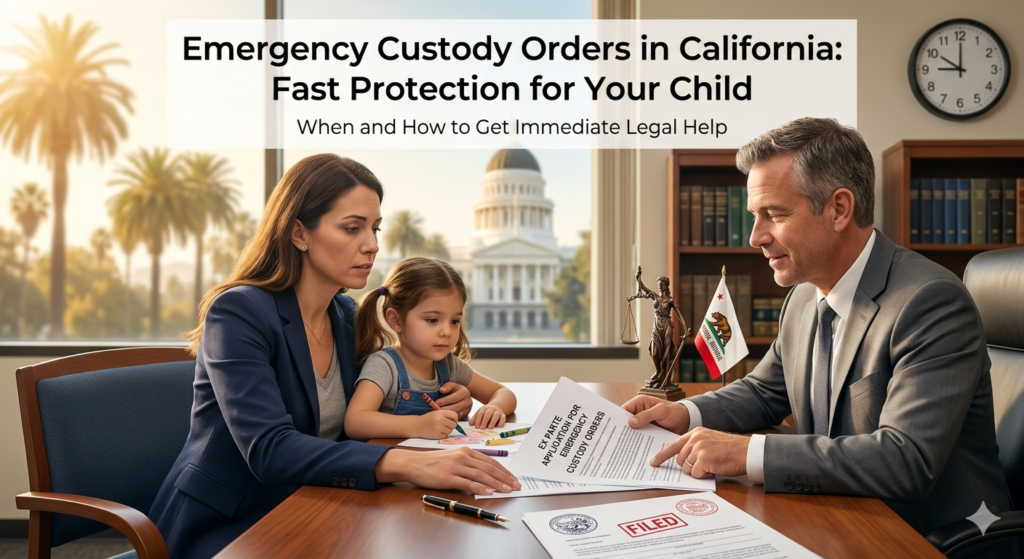
Aggressive Divorce Representation Available NowCall Us (805) 222-6766 Emergency Custody Orders in California: When and How to Get Fast Protection for Your Child Understanding Emergency Custody Orders in California When turmoil strikes a family, especially amidst legal disputes, waiting for standard court procedures can exacerbate stress and risk. In these moments, an emergency custody order stands out as a critical legal mechanism to swiftly protect a child’s well-being in California. These orders address urgent situations when a child’s safety is threatened, such as potential exposure to domestic violence or neglect. In a place as vibrant and diverse as Tarzana, California, understanding how emergency custody orders function within the broader spectrum of family law can be invaluable for parents seeking to minimize risk to their children. How Family Law Operates in California California’s approach to family law emphasizes laws designed to protect family members, particularly children. At the Law Offices of Seth C. Bowen, we leverage this framework to offer expert guidance across the counties of Los Angeles and Ventura. From its no-fault divorce system to community property laws where marital property is typically split equally, California’s legal system prioritizes equitable solutions. A key focus remains on the best interests of the child, especially in custody disputes. The courts aim to promote stability for children through joint custody arrangements when possible. However, they prioritize a child’s safety, often intervening with tools like emergency custody orders to ensure protection from immediate threats. The Legal Process for Obtaining Emergency Custody Orders Securing an emergency custody order in California involves an expedited legal process designed to quickly address child safety concerns: Filing a Petition: The process begins by filing a petition in court, detailing the reasons for urgent custody. Evidence supporting claims of risk to the child’s health or safety is critical. Request for Ex Parte Hearing: An ex parte hearing allows for expedited court intervention without prior notice to the other parent, often scheduled within a day or two of filing. Presenting Evidence: During the hearing, the petitioner must present compelling evidence of imminent harm or risk posed to the child, such as police reports or restraining order violations. Court Decision: The court may grant temporary custody arrangements that protect the child, lasting until a full hearing can be conducted. Full Hearing: A follow-up hearing is scheduled where both parties present their case for a longer-term custody decision. Fulfilling these steps requires meticulous preparation, often best navigated with the guidance of a knowledgeable family law lawyer. Failure to adequately prepare can result in delays or denial, risking a child’s safety. Comprehensive Family Law and Divorce Services The complexities inherent in family law extend beyond emergency matters. At the Law Offices of Seth C. Bowen, we offer a broad suite of services tailored to family law in California: Child Custody Children’s Rights and Welfare Child Support Divorce Domestic Violence Fathers’ Rights Grandparents’ Rights Modifying Court Orders Paternity Postnuptial Agreements These services ensure that regardless of the familial challenge, our clients receive well-rounded and experienced legal support. Expertise and Local Presence The foundation of our practice stems from Seth C. Bowen’s extensive legal education and dedication to serving the communities of Los Angeles and Ventura counties. A graduate of Loyola Marymount University and Chapman University School of Law, Seth and his team bring local expertise and personalized service to every case. His active involvement with the San Fernando Valley Bar Association and the Los Angeles County Bar Association further enhances our commitment to serving our clients with excellence. Recognized among the Best Divorce Lawyers in Ventura by Expertise.com in 2022, the firm’s reputation for providing compassionate and effective legal solutions is matched by its accessibility. We believe in treating every client’s issue as a priority and providing solutions that fit not only legally but practically for the families involved. Navigating Family Law and Divorce Cases in California The road through family law and divorce in California can be complex, requiring detailed navigation of various procedural steps: Residency Requirement: Ensure one spouse has met the 6-month residency requirement in California and 3 months in the filing county. File for Divorce: Initiate by filing necessary paperwork and paying filing fees. Preliminary Declaration of Disclosure: Both parties must complete and exchange this crucial step, ensuring transparency in financial matters. Serving Divorce Papers: Serve papers to the spouse and file proof with the court. Consider Alternative Resolutions: Mediation is recommended to resolve custody or support disputes, reflecting the state’s emphasis on non-adversarial solutions. Court Hearings: Attend court for unresolved issues related to custody, property, or support. Finalizing the Divorce: Achieve a divorce decree through a settlement agreement or after a trial. Involves decision over community property and spousal support. FAQs About Emergency Custody and Divorce in California What is an ex parte custody hearing in California? An ex parte hearing is an expedited court session without prior notice to the other parent, necessary in situations where a child’s immediate safety is at risk. How often do courts grant emergency custody orders? Orders are granted when there is credible evidence of immediate harm or risk to a child’s safety, such as domestic violence or neglect. Can a temporary custody order become permanent? Yes, temporary orders can lead to permanent arrangements if subsequent hearings determine it is in the child’s best interest. How does California determine child support? Child support follows guidelines based on parents’ incomes and custody arrangements, and any updates would ensure calculations consider all relevant factors. What must I prove to modify an existing custody order? To modify a custody order, you must demonstrate a significant change in circumstances that impacts the child’s welfare. Take Action to Protect Your Child Today In critical times where your child’s safety is concerned, immediate legal intervention is vital. The Law Offices of Seth C. Bowen not only offers sound legal advice but extends a free consultation to assess your situation right from the start. With our offices conveniently located in Tarzana, we are strategically positioned to serve clients